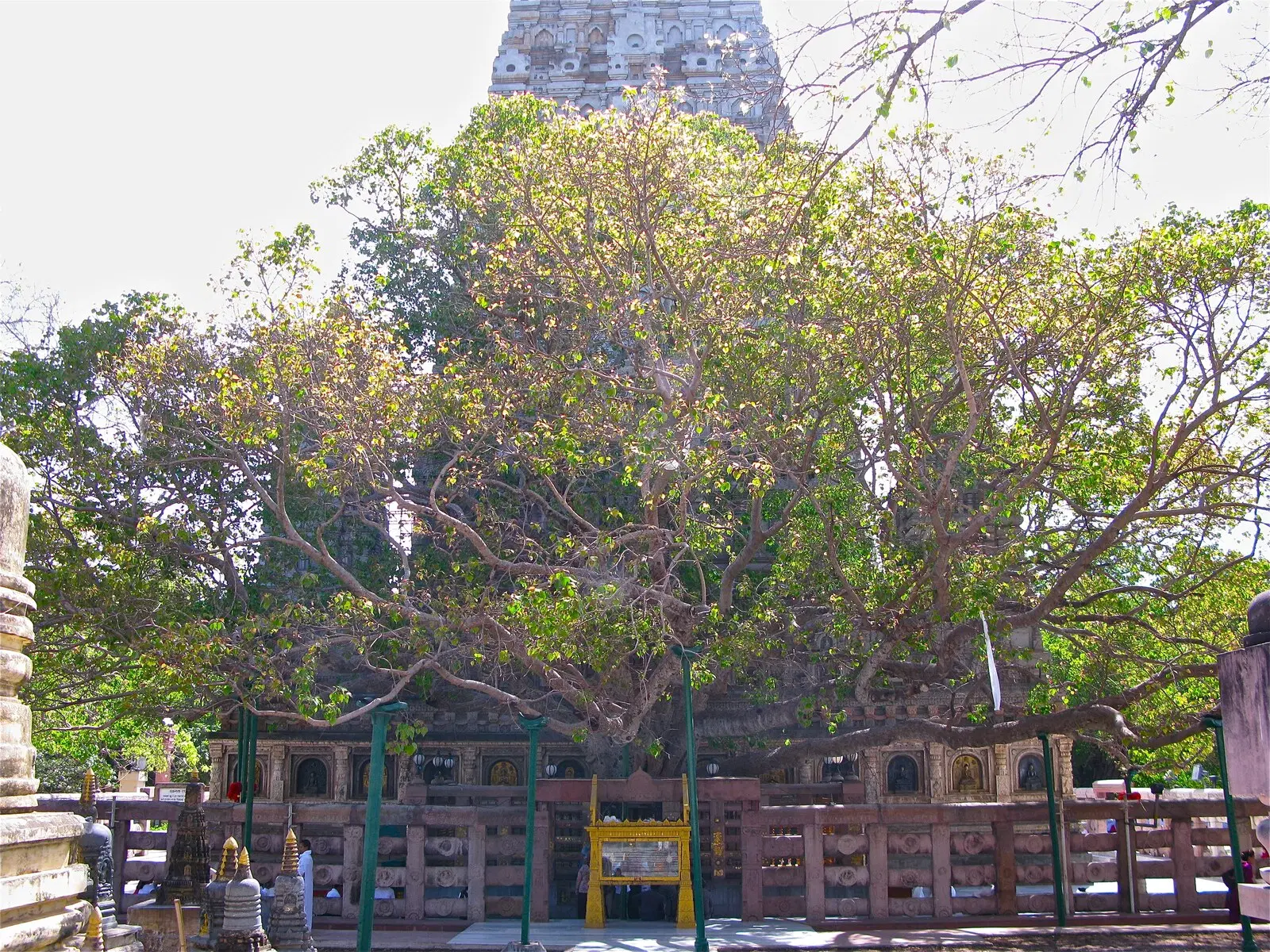
Bodhi tree
The Bodhi tree (Sanskrit and Pāli: Bodhi meaning "awakening" or "enlightenment") is the specific Bo tree (from the Sinhala bo, derived from bodhi)—a sacred fig (Ficus religiosa)—located within the Buddhist Mahabodhi Temple, a UNESCO World Heritage Site, in Bodh Gaya, Bihar, India. According to Buddhist tradition, it was under a Bo tree located at this site that Siddhartha Gautama, the spiritual teacher who later became known as Gautama Buddha, or simply the Buddha, attained enlightenment, or Buddhahood, around the 5th century BCE. In Buddhist art and iconography, the Bodhi tree is commonly depicted with its characteristic heart-shaped leaves, a feature of Ficus religiosa that has come to symbolize wisdom and spiritual awakening. The original tree no longer survives, but its descendants have been venerated for more than two millennia. Over the centuries, the tree and its successors have undergone many episodes of destruction and renewal. Notable recorded incidents include its felling during the reign of Emperor Aśoka (c. 268–232 BCE), its destruction by Queen Tissarakkhā around 254 BCE, its damage or destruction during the persecution of Buddhism under King Puṣyamitra Śuṅga in the 2nd century BCE, and its later cutting down by King Śaśāṅka of Gauda around 600 CE. Each time, it was replanted from surviving saplings. Source: https://en.wikipedia.org/wiki/Bodhi_tree Photo: Ken Wieland from Philadelphia, USA (CC BY-SA 2.0) Date: 2003-05-14 — Wikipedia article first written
- Data de plantação
- 14 de maio de 2003 ()
- Espécie ou variedade
- Ficus religiosa
- Tipo de cultura
- Árvore
- Localização
-
24° 41' 45.29" N, 84° 59' 29.29" E
Foto